
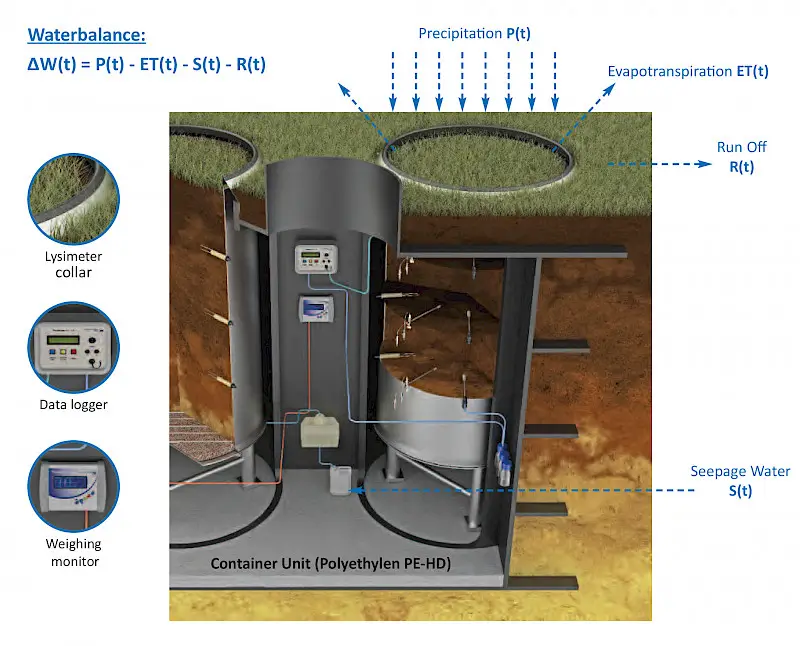
A lysimeter is a scientific instrument used to measure the amount of water that percolates through a soil column with a known volume and surface area and to analyze the movement of nutrients, salts, irrigation affects, or contaminants in the soil profile. It’s commonly used in agriculture, environmental science, and hydrology to study:
The Lysimeter soil column can be either filled manually with ‘reconstructed’ soil material or be equipped with an ‘undisturbed’ soil monolith excavated from the site of investigation. Lysimeter experiments can be either conducted in the laboratory (laboratory lysimeter) or in the field (field lysimeter).
Lysimeter experiments are a convenient method to determine water balance variables. In combination with precipitation measurements, it is possible to directly calculate the evapotranspiration rate by using the recorded mass change of a weighable lysimeter. Lysimeter experiments are utilized to investigate water balances of ecosystems or crop water use of rain fed crops. Lysimeters equipped with a leachate collecting system allow the quantitative and qualitative (in the laboratory) investigation of seepage water.
Further, lysimeters can be equipped with additional sensors such as tensiometers, soil moisture probes, thermometers, and suction probes which allow the investigation of the functioning and mechanisms of ecosystems. The results can be transferred from small to large scales. Due to the possibility of long-term field investigations under given site conditions, lysimeter experiments can be used to derive statements about the water balance under certain climate scenarios. A comparison of several identical lysimeters in areas with different weather conditions or a comparison of different soil types or different vegetation under the same weather conditions over a longer time period is also a common research goal. These investigations provide the foundation for many models to estimate the effect of climate change, the spread of contamination in the soil or the success of remediation measures.
A laboratory lysimeter is a controlled system designed to study water movement, solute transport, and soil-plant interactions under precise conditions. To ensure accurate measurements, the lysimeter is often housed within a protective structure that shields it from external factors like wind and temperature fluctuations.
How a typical laboratory lysimeter is structured:
A cylindrical container, often made of materials like polypropylene or stainless steel, holds the soil sample that replicates natural field conditions. The vessel can accommodate both disturbed (manually filled) and undisturbed soil monoliths, depending on the study’s requirements. This monolith serves as the medium through which water and nutrients move, allowing for accurate measurement of these processes.
The entire lysimeter setup is placed on a high-precision scale or load cells. This allows for continuous monitoring of weight changes, which correspond to water loss through evapotranspiration or gain through irrigation.
An integrated irrigation head or sprinkler system simulates rainfall or watering events. This system can be controlled to apply specific amounts of water at designated intervals.
Advanced lysimeters are equipped with various sensors to monitor. These instruments provide real-time data on soil conditions, enhancing the understanding of water and nutrient dynamics.
At the base of the soil column, a drainage layer collects percolating water. This system often includes a collection pan or reservoir to gather leachate for analysis, providing insights into nutrient leaching and groundwater recharge.
A central control unit manages the operation of the lysimeter, including irrigation scheduling, data logging from sensors, and environmental controls like temperature and humidity.
Growth chambers are specialized controlled-environment units used to simulate and manipulate environmental conditions (like temperature, light, humidity, and CO₂ levels) for research and development in various scientific fields. Here’s how they are applied in different branches of science:

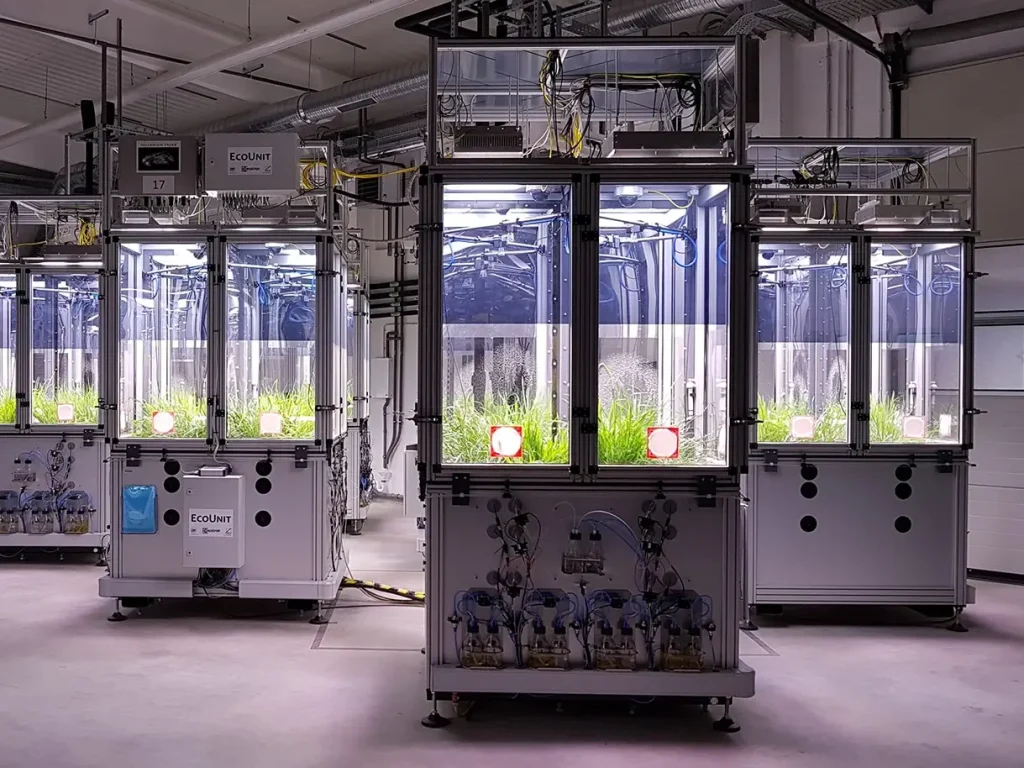
The UGT EcoLab flex flex is a new generation of ecotrons where the optimal technical support to answer your research questions is our goal. The EcoLab flex can be designed e.g. as a single ecotron with one lysimeter, as a single ecotron with several stackable lysimeters or as a double station.
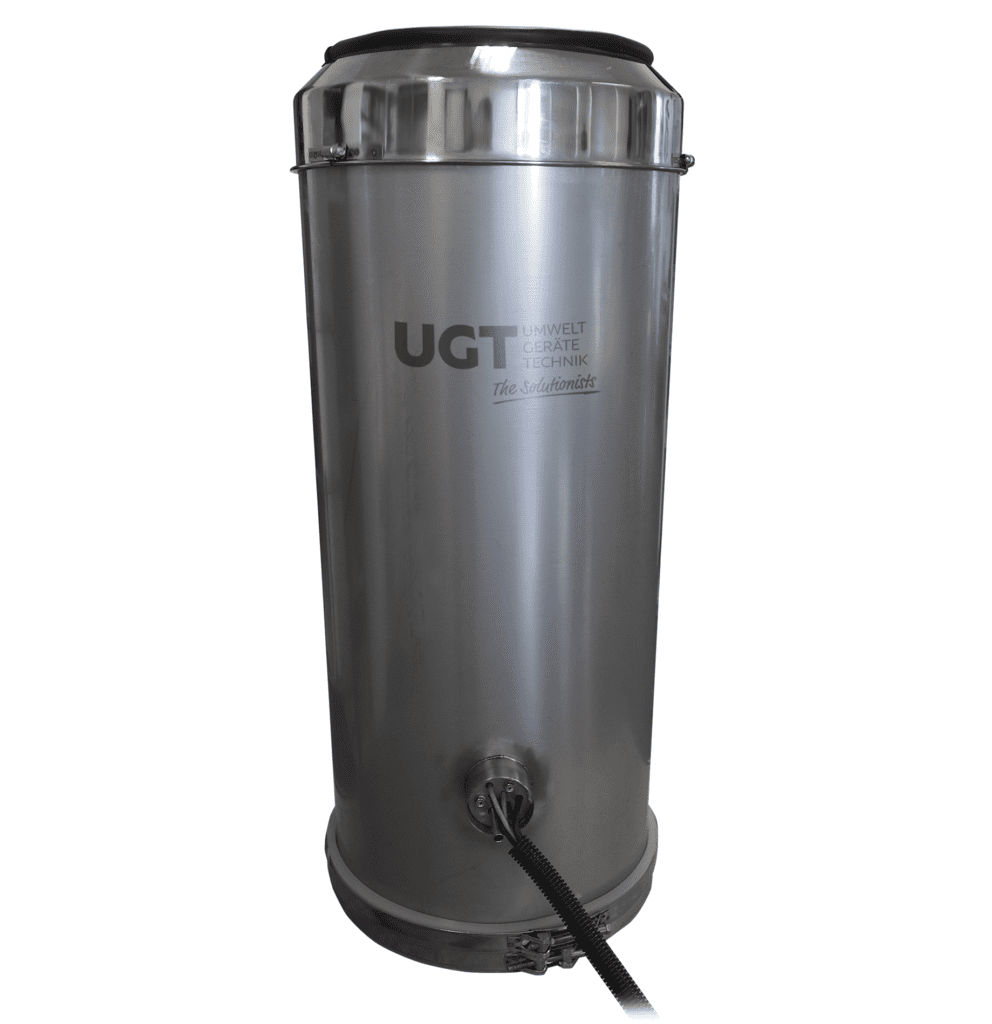
The UGT Easy-To-Go Lysimeter (ETG) provides all the essential features for determining the key components of soil water balance.
The ETG consists of a lysimeter vessel with a diameter of 300 mm and a height of 600 mm, along with two soil moisture and temperature sensors, a tipping counter, a weighing system, and a data logger enclosure. The data is transmitted wirelessly to a data management portal. All ETG units are suitable for both constructed and undisturbed soil monoliths (using specialized sampling technology). The ETG lysimeter station can be set up and operated with standard tools—no training is required.

The UGT Lab Lysimeter is a small weighing lysimeter lab setup suitable for both Constructed and Undisturbed soil monoliths. The Lab Lysimeter has applications in the water budget and ET studies.
The Soil Column setup is similar to the Lab Lysimeter. The Soil Column setup does not have a weighting feature, and it is suitable for soil hydrology and chemical transport modeling.
There are several options of diameter (200 to 800 mm) and height (200 to 1,500 mm).

To complement the product line, UGT has developed a smaller and more cost-effective solution for field studies in addition to the large PE-HD lysimeter stations. The Ready-To-Go Lysimeters are small weighable lysimeter stations suitable for monoliths with a diameter of 300, 500, 800 or 1130 mm and a length of 300, 600 or 900 mm. All Ready-To-Go Lysimeters (RTG) are suitable for both disturbed (filling by hand) and undisturbed soil monoliths (using specialized sampling technique). The entire RTG lysimeter station can be set up and put into operation without special tools and also without trained UGT personnel. The standard RTG system consists of a stainless steel lysimeter vessel, a weighing system, a leachate tank with tipping trough, a set of high-precision and accurate-fitting soil hydrological sensors, and a control station for each. With UGT sensors such as tensiometers, water content and temperature probes, and suction probes, we can help you study ecosystem function and effects. The RTG system can be extended by a pore-water harvesting system and the UGT weather station module with climate sensors.